
 GET THE APP
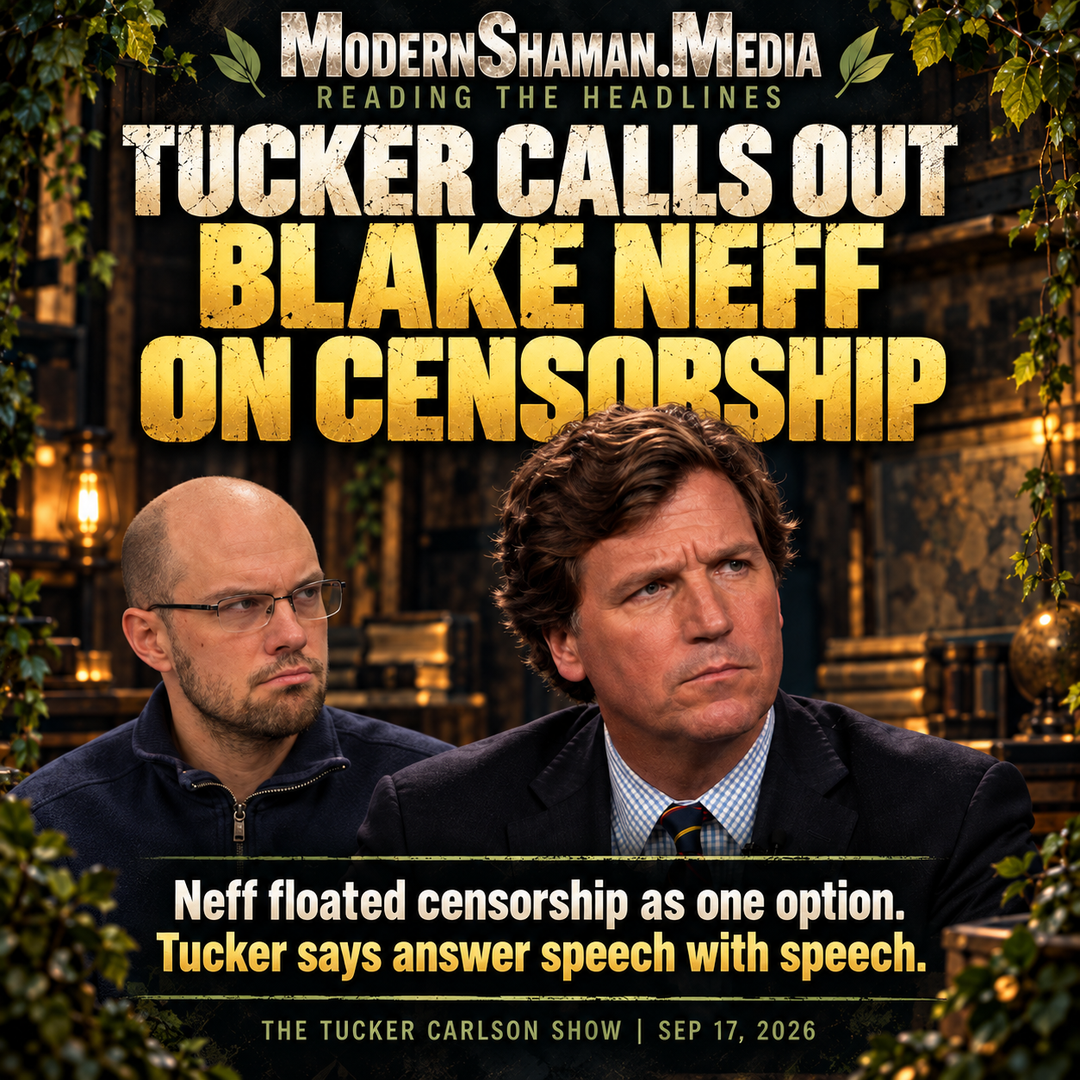
Tucker Calls Out Blake Neff On Censorship
Tucker Carlson challenges Blake Neff's suggestion that censorship belongs among the options for confronting online claims. My view: a free-speech principle has to survive speech we dislike.
I'm on Tucker Carlson's side on this one. The moment free speech gets uncomfortable is the moment defending it actually means something. If you only protect people while they say things you approve of, you are offering permission, and permission can be taken away.
In the September 17 episode of The Tucker Carlson Show, Carlson challenged a passage from Ian Ward's Politico profile of Blake Neff. The clip circulated in the Candace Owens post embedded below. Neff's statement presented two possible paths for confronting online claims: accepting censorship or finding a way to combat those claims without it. Tucker objected to putting the first option on the table at all.
The phrase that set Tucker off was "make our peace with censorship." For me, that is the center of this story. Once censorship becomes an acceptable tool, the argument shifts to who gets to use it, whose speech gets restricted, and which opinions the people holding power consider too dangerous to hear.
Tucker's answer was to rebut the speech and offer a more convincing account. That is the argument I support. If somebody is wrong, show us where they are wrong. Bring the evidence. Let people hear both arguments and make up their own minds. A public platform gives you room to respond; it should not become authority to decide that everyone else has finished talking.
Neff subsequently told Jeremy Boreing, in their September 22 interview, "I support maximal free speech," and said he had not called for YouTube to ban Candace Owens. His original either-or statement also included a path without censorship. My criticism is of allowing censorship into the discussion as a possible solution, the precise point Tucker challenged.
I do not see why having a stronger argument would require making the other person disappear. When people already distrust the story they are being told, restricting discussion gives them another reason to distrust the people telling it. Answering questions in public is harder work, but it lets an audience see the reasoning instead of simply being told which voices remain acceptable.
This matters beyond a disagreement between two media personalities. Independent creators live with the consequences of other people deciding whether their work can be seen. A principle that protects unpopular speech is useful to the person with a phone and an audience just as much as it is to the person sitting in a major studio.
That is why Tucker's criticism lands with me. A commitment to free speech has to hold when the criticism becomes personal, when the audience asks unwanted questions, and when defending the principle costs something. I support answering with evidence and more speech. Making peace with censorship is a concession I do not want the movement making.
Watch the source post below. This commentary is published September 30, 2026, and discusses Carlson's September 17 segment and Neff's September 22 response.